
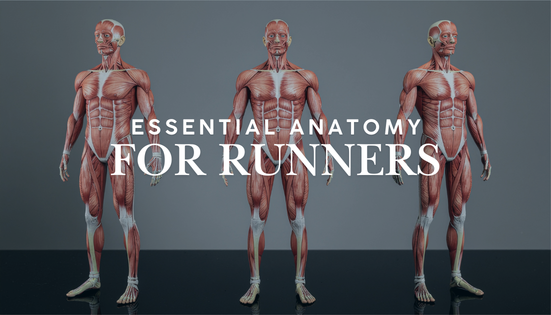
Understanding what’s actually hurting — and why — is one of the most important steps in recovery.
Many runners come into the clinic saying things like:
- “I pulled a muscle… I think?”
- “My knee hurts, but I don’t know what part.”
- “Is this a tendon or a ligament?”
You’re not alone. Most people were never taught basic anatomy in a way that actually applies to running. This guide breaks down essential lower‑body anatomy in plain language so you can better understand your body, your pain, and your recovery.
First: The Building Blocks of Movement
Before we talk about specific muscles, it helps to understand the types of tissue in your body.
Muscle
- What it does: Creates movement and absorbs force
- What it feels like when injured: Tightness, soreness, cramping, or pain with contraction or stretching
- Example: Quads, hamstrings, calves
Muscles are the engines that move you forward when you run.
Tendon
- What it does: Connects muscle to bone and transfers force
- What it feels like when injured: Stiff or achy pain, often worse at the start of a run and easing as you warm up
- Example: Achilles tendon, patellar tendon
Tendons don’t like sudden changes in training volume or intensity.
Ligament
- What it does: Connects bone to bone and provides joint stability
- What it feels like when injured: Sharp pain, instability, swelling
- Example: ACL, ankle ligaments
Ligament injuries are less common in running but can happen with twists, falls, or uneven terrain.
Bone
- What it does: Provides structure and absorbs load
- What it feels like when injured: Deep, localized pain that worsens with impact
- Example: Tibia, femur, metatarsals
Bone stress injuries often start subtly and get worse if ignored.
The Major Muscle Groups Runners Should Know
Quadriceps (Quads)
- Location: Front of the thigh
- Job: Straighten the knee, control downhill running
- Common issues: Front‑of‑knee pain, patellar tendon pain
If pain is in the front of your thigh or knee, your quads are often involved.
Hamstrings
- Location: Back of the thigh
- Job: Bend the knee, help extend the hip
- Common issues: Strains, tightness, tendon pain near the sit bone
Hamstring pain is usually felt in the back of the leg. Some hamstring injuries can refer pain to the knee.
Glutes
- Location: Butt muscles
- Job: Hip stability, propulsion, control of pelvis and knee
- Common issues: Hip pain, IT band pain, low‑back overload
Weak or underused glutes often lead to injuries below the hip.
Calves
- Location: Back of the lower leg
- Job: Push‑off and shock absorption
- Common issues: Calf strains, Achilles tendon pain
Calves take a huge load when running — especially with hills or speed work.
Joints That Matter Most in Running
Hip Joint
- Transfers force from your legs to your torso
- Poor hip control often shows up as knee or foot pain
- True hip joint pain will be present in the groin and front of the thigh, with a similar feeling to a groin strain. Muscle imbalances and strains in the hip will often be present on the side or back of the hip.
Knee Joint
- Acts as a force‑transfer joint
- Knee pain doesn’t always mean the knee is the problem. Lack of mobility and/or stability at neighboring joints is often the culprit.
Ankle & Foot
- Absorb impact and adapt to the ground
- Limited mobility here can overload the calf or knee
How Anatomy Helps You Understand Pain
Knowing what hurts helps guide what to do next.
- Muscle pain often responds well to load management and strengthening. Acute muscle injuries need rest from high-level activity.
- Tendon pain needs progressive loading, not rest alone
- Joint pain may signal movement or strength issues elsewhere
- Bone pain should never be pushed through
Pain is a signal — not a diagnosis — but anatomy helps you interpret that signal.
Why This Matters for Recovery
If you don’t know what tissue is injured, it’s easy to:
- Do the wrong exercises
- Rest too much (or not enough)
- Follow random advice online
Understanding basic anatomy allows you to be an active participant in your rehab instead of guessing.
The Bottom Line
You don’t need to be an anatomy expert — but knowing the difference between a muscle, tendon, ligament, and bone can completely change how you approach injury.
At Omega Project PT, we help runners understand why they’re hurting and how to fix it — not just treat symptoms.
If pain is keeping you from running, let’s figure out what’s actually going on.
