
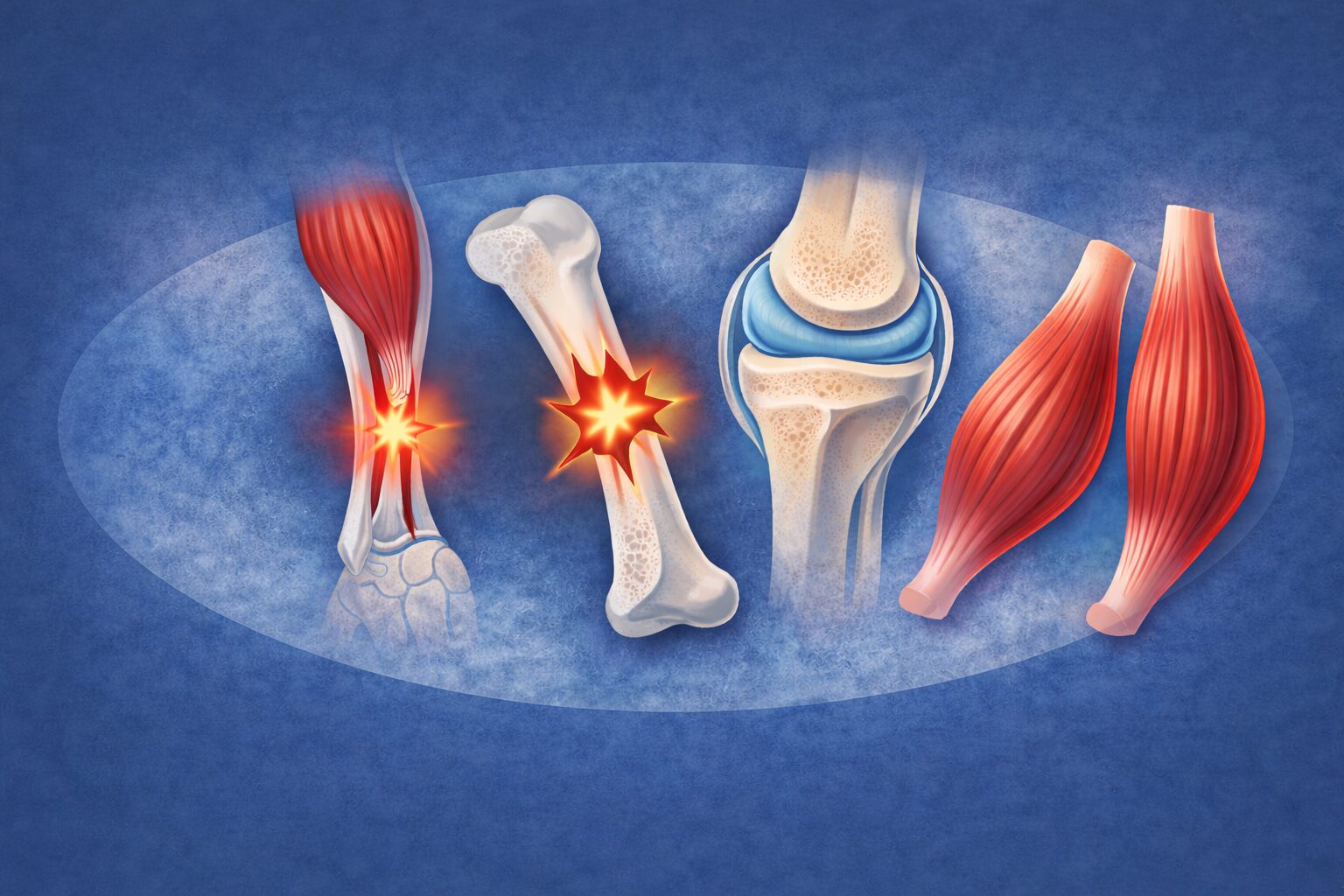
Pain isn’t random.
The type of pain you feel often points to which tissue is irritated. How it starts, how it behaves, and what makes it better or worse can tell you a lot about what type of injury you’re dealing with. It can even help guide you toward the next steps, whether that’s rest, physical therapy, or continuing at your current activity level.
Understanding these patterns can help you better explain your symptoms, avoid common mistakes, and get the right treatment sooner.
Let’s break down the most common tissue types we see in rehab and how they typically feel.
Tendon Pain (Tendinopathy)
What it often feels like:
-
Burning, achy, or sharp pain near a joint
-
Pain right where the tendon attaches to the bone
-
Stiff or painful at the start of activity, then eases as you warm up
-
Pain returns later that day, the next morning, or when you get up after a period of rest (sitting)
Classic signs:
-
“It hurts when I start running, but it gets better after a few minutes.”
- “It hurts when I first get up in the morning.”
-
Worse with repeated loading (running, jumping, lifting)
- It can also get worse after a sudden drop in activity (i.e., rest doesn’t help)
-
Sensitive to touch or pressure
Why this happens:
Tendons don’t like sudden spikes in load. When they’re overloaded or under-prepared, they become sensitive—but not necessarily “torn.”
Important note:
Stretching and rest usually do not help tendon pain and can make it worse.
Muscle Pain
What it often feels like:
-
Dull ache, tightness, or soreness
-
Pain during contraction or stretching
-
Localized tenderness
- Can be sharper and more severe pain if it was an acute or traumatic injury (muscle tear versus muscle strain)
Classic signs:
-
Feels better with light movement or warming up
-
Improves in days to several weeks, depending on the severity of muscle damage
-
Sore after new or intense activity
Why this happens:
Muscle strains and subacute injuries are often due to poor movement mechanics or training overload. Acute injuries, such as muscle tears, often result from explosive movements that the body is not able to handle. This could be activity-related (e.g., playing an explosive sport) or due to specific muscle fatigue.
Important note:
If muscle pain lingers or keeps coming back, something else (like poor movement mechanics or tendon overload) may be driving it.
Joint Pain
What it often feels like:
-
Deep ache or pressure inside the joint
-
Stiffness, especially in the morning or after sitting
-
Clicking, catching, or grinding sensations
Classic signs:
-
Worse with compressive positions (deep squats, prolonged sitting)
-
Limited range of motion
-
Pain feels “inside” rather than on the surface
Why this happens:
Joints are sensitive to compression, poor alignment, and repetitive stress.
Important note:
Joint pain is often influenced by how nearby muscles control movement—not just the joint itself. They can also be influenced by a lack of mobility or stability at neighboring joints.
Bone Pain (Stress Reaction / Stress Fracture)
What it often feels like:
-
Deep, localized ache in one specific spot
-
Sharp or intense pain with impact (running, jumping)
-
Pain that worsens the longer you continue the activity
-
Tenderness when you press directly on the bone
Classic signs:
-
Pain starts during activity and becomes progressively worse
-
Pain may linger long after you stop
- Pain with single-leg hop
-
Eventually hurts even with walking or daily activities
-
Pain becomes more predictable and easier to reproduce over time
Why this happens:
Bones adapt to load just like muscles and tendons—but more slowly. When impact increases faster than the bone can adapt, the bone becomes irritated (stress reaction) and can progress to a stress fracture if loading continues. Poor mechanics can also put you at increased risk of developing bone stress injuries because the bone gets overloaded more than it should.
Important note:
Unlike tendons or muscles, bone pain does not “warm up and feel better.”
If impact pain keeps worsening as you go, that’s a red flag.
Nerve Pain
What it often feels like:
-
Burning, tingling, electric, or sharp pain
-
Numbness or pins-and-needles
-
Pain that travels or radiates into the leg/foot or arm/hand
Classic signs:
-
Pain follows a nerve pathway (down an arm or leg)
-
Worse with certain positions (sitting, bending, neck movement)
-
Strength or sensation changes
Why this happens:
Nerves don’t like being compressed, stretched too much, or irritated.
Important note:
Nerve pain rarely responds well to stretching or massage alone and needs specific treatment. A good sign of healing is when the pain/symptoms start to centralize in the neck or back rather than radiate into the arm or leg.
Visceral (Organ-Related) Pain
What it often feels like:
-
Deep, vague, or hard-to-pinpoint pain
-
Cramping or pressure
-
Pain not clearly linked to movement
- Each organ has a referral pattern (i.e., gall bladder and right shoulder)
Classic signs:
-
Pain doesn’t change much with position or activity
-
Associated symptoms (digestive issues, fever, nausea)
-
Pain feels “deeper” than muscle or joint pain
Why this matters:
This type of pain is not a musculoskeletal injury and needs medical evaluation.
Why This Matters for Recovery
If you treat every pain the same way, you’ll often stall your progress.
For example:
-
Stretching a painful tendon can delay healing
-
Resting a tendon too long can make it weaker
-
Strengthening without addressing nerve sensitivity can worsen symptoms
That’s why guessing—or copying exercises from the internet—often doesn’t work.
The Big Takeaway
Pain is information.
The quality, timing, and behavior of your pain often point to the tissue involved—but proper diagnosis still matters.
At Omega Project PT, we don’t just ask where it hurts.
We look at:
-
How it behaves
-
When it shows up
-
How you move
-
What loads your body can (and can’t) tolerate
- Where is the root of the problem
That’s how we build a plan that actually works and gets you back to doing what you love as quickly as possible.
