
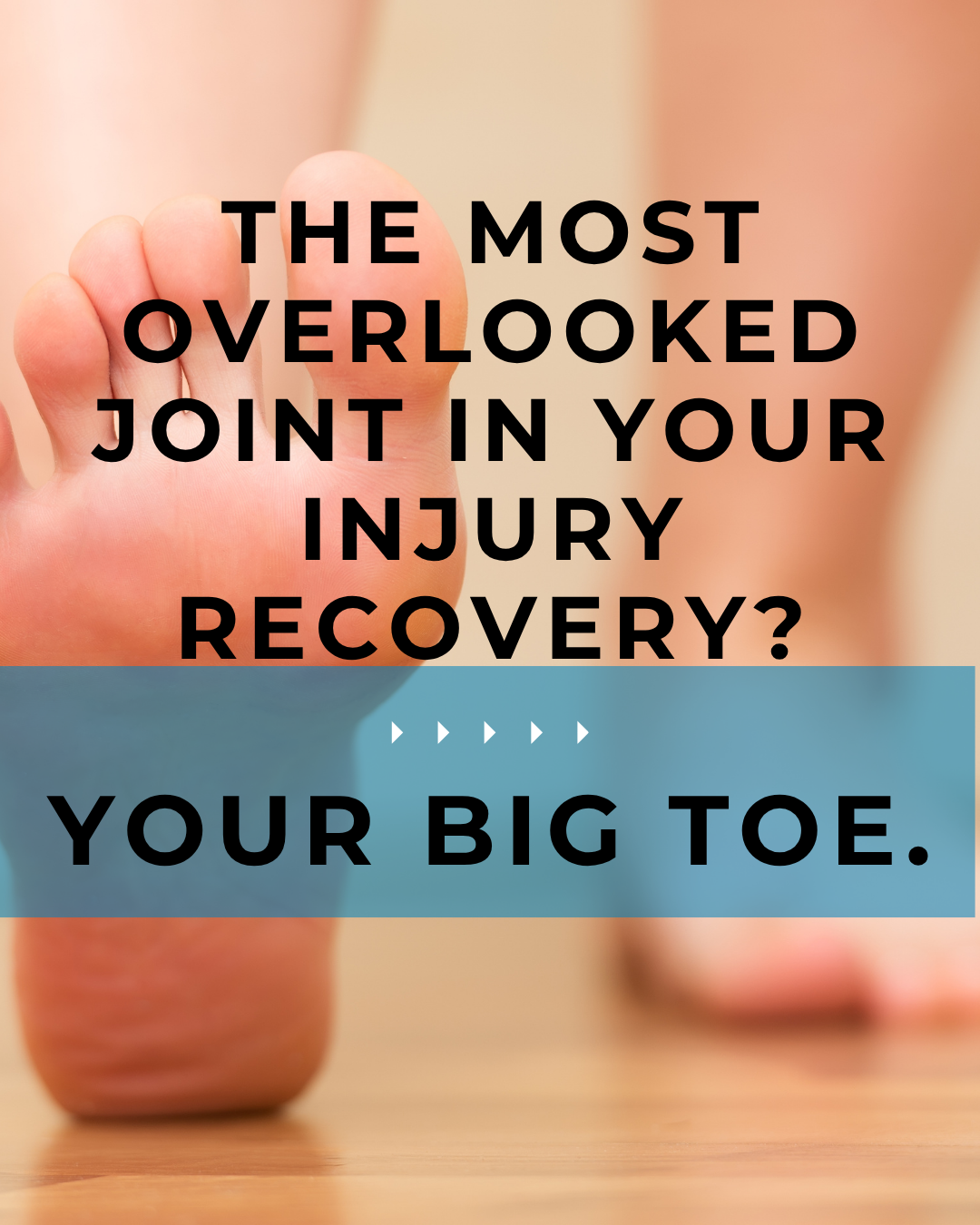
If you’ve dealt with hip pain, knee pain, or nagging foot problems as a runner or athlete, you’ve probably had your hip strength tested, your knee mechanics analyzed, maybe even your running form reviewed on video. What almost never gets checked (by patients or, frankly, by a lot of clinicians) is your big toe.
That’s a problem because, over years of treating hip, knee, and foot injuries in runners and athletes, one pattern keeps showing up: weakness in the big toe. It’s rarely the reason people come to the clinic. But it’s often part of why they ended up there.
Why Your Big Toe Matters More Than You’d Think
Your big toe is the last point of contact your foot has with the ground before you push off. Every step, stride, and jump funnels force through it. A few things depend on it working well:
- Push-off power. Your big toe and the muscles that flex it generate a real share of the force that propels you forward when you walk or run. When it’s weak, your body finds that power somewhere else.
- The windlass mechanism. As your big toe bends upward during push-off, it automatically tightens the tissue along the bottom of your foot (the plantar fascia), helping your arch stiffen at just the right moment. That only works if your toe can move and load properly.
- Stability through your foot. A strong, stable big toe helps control how much your foot rolls inward as you land and push off. Without that stability, the job gets passed up the chain to your ankle, knee, and hip.
When your big toe can’t do its job (whether from weakness, stiffness, or both), the rest of your leg doesn’t just stop working. It compensates. And compensation is often where overuse injuries quietly begin.
The Compensation Pattern I See Most Often
A weak or restricted big toe tends to shift load in predictable directions:
- Your foot rolls in more. Without your toe stiffening the arch at the right moment, your foot tends to over-pronate and stay collapsed longer through each step.
- Your hip picks up the slack. To compensate for weak push-off, many athletes start relying more on their hip flexors and the muscles along the outside of the hip. Over time, that shows up as front-of-hip pain, IT band irritation, or glutes that just won’t “turn on.”
- Your knee drifts inward. Poor stability starting at the foot often contributes to the knee caving in during landing or stance, a well-documented risk factor for kneecap pain and more serious injuries like ACL tears.
- Your plantar fascia and shin take on more strain. Without your big toe assisting the windlass mechanism, the tissue on the bottom of your foot and the muscles along your shin end up absorbing extra load. This is a common contributor to plantar fasciitis and shin splints.
To be clear: a weak big toe doesn’t cause every hip or knee injury. But it’s frequently a contributing factor that often goes unaddressed, which means rehab plateaus or injuries keep coming back for reasons that seem to make no sense.
Why It Gets Missed
A few reasons this joint tends to fly under the radar:
- It’s small, and small joints get a lot less attention than big, dramatic ones.
- Weakness here usually doesn’t cause pain in the toe itself, so you’d have no reason to bring it up.
- It isn’t part of most standard injury screens.
- Many clinicians were never specifically trained to test it in isolation.
That means you can go through a thorough hip and knee workup and still walk away with a meaningful piece of the puzzle unexamined.
How I Assess It
When I’m evaluating a runner or athlete with hip, knee, or foot pain, I now build in a specific check of big toe function (something that’s easy to miss if you’re not looking for it). Here’s what that typically looks like in a session with me:
- A manual strength check. In a staggered-stance position, I’ll have you press down with your great toe onto a piece of paper. If I can easily pull the piece of paper out, that signals weakness in the toe flexors. This indicates less powerful push-off.
- A test of toe extension. I’ll also check how well you can lift and hold your big toe upward against resistance, since weakness there often indicates compensation elsewhere in your stride.
- A “doming” or short foot test. I’ll ask you to gently scrunch your foot to create an arch without curling your toes. Struggling with this often overlaps with poor control of the big toe.
- Watching how you load your toe during a step or lunge. I’ll observe whether your big toe is actually bearing weight through push-off, or whether you’re unconsciously shifting your weight to the outside or inside of your foot to avoid it.
- A mobility check. I’ll also move your big toe through its range to see how well it extends. You generally need somewhere around 60–70 degrees of extension for normal walking and running mechanics. If you don’t have it, strength alone won’t fully solve the problem.
None of this takes long, but it’s often the missing piece in a bigger picture that hip or knee exercises alone haven’t fully resolved.
What Rehab Looks Like
If I find weakness, the good news is that the big toe responds well to the same kind of progressive, targeted training we’d use anywhere else in the body. It’s just a muscle group most people have never trained on purpose.
Early on, we’ll usually start with simple isometric work: pressing your toe down against a towel or the floor, towel scrunches to wake up the small muscles in your foot, and some hands-on resistance work in session. It can take some guidance and individualized exercise prescription to make sure you’re not adding to a compensatory pattern.
As you build strength, we’ll progress to resisted toe flexion with a band or towel, single-leg “doming” holds, and drills that specifically train you to push off through your big toe rather than the outside or inside of your foot.
Once you’re stronger, we integrate it into function: single-leg balance work with active toe engagement, calf raises that emphasize push-off through the big toe, and eventually sport-specific drills with cues to fully extend and load through the toe.
Don’t Forget Mobility
Strength isn’t the whole story. Your big toe can be strong but stiff, and stiffness limits the windlass mechanism just as much as weakness does. This shows up often in athletes with a history of turf toe, bunions, or years spent in narrow, stiff-soled shoes. If I find limited mobility, we’ll add joint mobilizations, self-mobilization with a band, and time spent barefoot to work on toe spreading and extension. It’s worth addressing alongside strength, but strength is usually the bigger, more overlooked piece.
The Takeaway
Training your big toe won’t replace the rest of your hip or knee rehab program. But if you’ve dealt with a stubborn or recurring hip, knee, or foot injury, it’s worth five extra minutes in your next evaluation to check it. It’s a small joint with an outsized job. When it’s not pulling its weight, something else further up the chain usually is, until eventually it can’t keep up anymore.
If it’s been a while since anyone checked your big toe strength and mobility, it might be worth bringing up at your next visit.
